Transnational Identities on Okinawa’s Military Bases by Johanna O. Zulueta
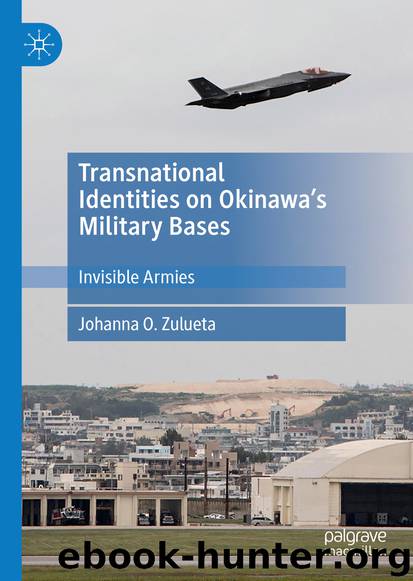
Author:Johanna O. Zulueta
Language: eng
Format: epub
ISBN: 9789813297876
Publisher: Springer Singapore
The Nisei emphasize both their roots, while claiming to be part of both Okinawa and the Philippines.
Moreover, these Nisei engage in boundary-making processes particularly when claiming a “half-Okinawan” identity, thereby distinguishing themselves from other so-called mixed identities in Japanese and Okinawan society, such as the Amerasians, the Philippine Nikkeijin (Japanese -Filipinos), and the so-called Japanese-Filipino Children/Youth (JFC/JFY), who are mostly offspring of Japanese men and Filipino women who came to Japan as workers and marriage migrants from the early 1980s. This claim to being “hāfu” can be regarded as a form and a source of empowerment for the Nisei as they negotiate their mixed ethnic identity with notions of being “Japanese”/ “Okinawan” in present-day Okinawan society. Holders of Japanese nationality, they are “Japanese” in a legal sense, but their being “half”, coupled with their inadequate Japanese language proficiency and cultural literacy, as well as their “un-typical Japanese” mannerisms, contradicts what being “Japanese” is. The Nisei then exist between being “excluded” and “included” in the category of “Japanese”. They are Japanese legally, culturally though they are not. For some of these Nisei, being Japanese is more of a legal identity. This, I realized, one Sunday in September 2013 while conversing with Noel Tōma, a Nisei parishioner at Oroku Catholic Church. When we were talking about his recent trip to the Philippines where he availed of senior citizen discounts by using his Filipino name, he then told me (after probably seeing a surprised look on my face), “Sa papel lang ako Hapon (I am Japanese only on paper)”—apparently suggesting the instrumentalist view he has on his Japanese nationality and how he locates himself within the category of being “Japanese”.
For the Nisei, being “hāfu” is less about cultural markers, but more about consanguinity. The claim to being “hāfu” is, for many of them, an assertion of one’s roots and “blood” relation to an Okinawan parent despite not exhibiting cultural traits of being “Okinawan”. It can be said that this particular claim to an identity works to serve as cultural capital as well as a “passport” to be able to enter the Japanese labour market. This claim also enables them to craft a sense of belongingness in an Okinawa that is ambivalent towards people like them. I will be discussing this more in Chap. 5. Meanwhile, to understand further how “mixed” identities are perceived in Okinawan society, I turn to a short discussion on so-called hāfu identities and locate this within the discourse of racialization in Japan/Okinawa.
Download
This site does not store any files on its server. We only index and link to content provided by other sites. Please contact the content providers to delete copyright contents if any and email us, we'll remove relevant links or contents immediately.
| Africa | Americas |
| Arctic & Antarctica | Asia |
| Australia & Oceania | Europe |
| Middle East | Russia |
| United States | World |
| Ancient Civilizations | Military |
| Historical Study & Educational Resources |
The Sympathizer by Viet Thanh Nguyen(4462)
The Rape of Nanking by Iris Chang(4276)
World without end by Ken Follett(3522)
Ants Among Elephants by Sujatha Gidla(3500)
Blood and Sand by Alex Von Tunzelmann(3255)
Japanese Design by Patricia J. Graham(3230)
The Queen of Nothing by Holly Black(2687)
City of Djinns: a year in Delhi by William Dalrymple(2589)
India's Ancient Past by R.S. Sharma(2498)
Foreign Devils on the Silk Road: The Search for the Lost Treasures of Central Asia by Peter Hopkirk(2495)
Tokyo by Rob Goss(2485)
Inglorious Empire by Shashi Tharoor(2473)
In Order to Live: A North Korean Girl's Journey to Freedom by Yeonmi Park(2416)
Tokyo Geek's Guide: Manga, Anime, Gaming, Cosplay, Toys, Idols & More - The Ultimate Guide to Japan's Otaku Culture by Simone Gianni(2412)
India's biggest cover-up by Dhar Anuj(2386)
The Great Game: On Secret Service in High Asia by Peter Hopkirk(2379)
Goodbye Madame Butterfly(2295)
Batik by Rudolf Smend(2222)
Living Silence in Burma by Christina Fink(2098)
